
In my younger days, I spent a lot of time at the other end of Warwick Road. Because of the nature of cricket, the players are less remote from the audience. There are large portions of any match when they are not actively involved and you are quite likely to come across them doing other things. At grounds other than Old Trafford (smaller opposition grounds, like Buxton and Chesterfield, or the out-grounds like Blackpool and Liverpool) this was even more true. And of course they didn't have a separate training ground.
The footballers by contrast seemed to sweep in for matches and then sweep out again. And the explosive nature of a football match is more like their being on a stage, apart from those watching. And of course the experience of watching football itself is shorter, more intense, whereas a cricket match, even a one-day game, unravels itself on a wholly different time-frame.
So I have never quite rid myself of this difference, that football is a performance, something that lifts you out of yourself, whereas cricket is part of the real world, entwined into its fabric. Maybe it is just the time a match lasts. After all, within the compass of a county championship match a man could be condemned, crucified and rise from the dead (and these days still have a day free to spend on the golf course).
Even before the amounts of money made footballers so separate, cricketers were much less remote as a species. Is is sad, perhaps, that it's no longer possible for players to pursue professional careers in both sports; Botham's little excusion with Scunthorpe was an eccentricity, no more. Even in my day, they were a dying breed. I saw Chris Balderstone play both games and Jim Cumbes.
Now we just wonder how good a cricketer Phil Neville might have been. He has, of course, had a successful football career and made himself a very rich man, but he has never really been the stuff of legend, even if he has been there whilst they we were being made.
I sometimes wonder if he might not have sacrificed a good part of his football career for one match winning performance in a Test match against Australia.
Although I doubt if he would have sacrificed any of it for the chance to bring the county championship back to Lancashire, much more important though that might be to an awful lot of people, who still hope to see it in their lifetimes.
Thursday, 26 July 2007

His Time Had Gone
In Alex Ferguson's recent interview in Macau with the assembled press, one passage struck me in particular. Asked how Arsenal would cope without Henry, he said,
"They lost him in December. I don't think they'll suffer too much. His time had gone and I think Arsene knew that."
One of the perverse attractions of sport, and of sporting heroes, is the brevity of that "time", the "pity that youth does not last".
They talk about the brevity of a sporting career (usually it seems these days as some facile justification for relatively mediocre talents being paid more in a year than, say, a nurse in a lifetime), but that window of "time" may be just a fragment of a career. In some cases, it seems it may be little more than one afternoon, to be in the right place at the right time. So much of it is luck.
You are never quite sure when a player's time has gone, when even the finest of players is no longer tuned to a team's subtle dynamic, or has started down the far side of his career.
I think Eric sensed it himself, but there are not that many who do "go out at the top", and indeed, there never have been. But in earlier days, a footballer had little choice but to ply his trade as long and wherever he could, because he had rarely been able to put that much money by. The pub and the Soreen factory lay in wait. Nowadays, a player with even a few seasons at the top should be comfortably insulated against a poverty-stricken old age.
Some players, obviously, just want to keep playing as long as they conceivably can, invent new and different roles and careers for themselves, which do not detract from what went before. Paul McGrath at Aston Villa; Dwight Yorke, for example, with his holiday in Australia, his World Cup and now his time at Sunderland; Sheringham, at West Ham and wherever he's now off to; Irwin and Ince at Wolves. Presumably, they are not driven entirely by money, unless they have gambled it all away, as much as by fear of what life may hold for them when they have to stop. They must all have heard those old players saying that nothing else is ever as good.
"Probably this is my fourth team — you could even say it's my fifth — but it's certainly my fourth, so there are moments when you have to make decisions regarding players' futures, which isn't easy because you get attached to them. You can't keep them forever and give them a pension. There comes a point where they have to move on. We did that and it was hard. But it was for the right reasons. We had to evolve and I knew that."
And I think supporters become even more attached to players. For myself, I think I retain a soft spot for anyone who has ever played for United, which is probably becoming obvious. Even Prunier and Taibi had their solitary moment in the sun and were endearing in the monstrosity of it all. If I had my way, we'd probably never get rid of anyone (well, Kieran going was probably the right move for all concerned, and the same will go for Smudger when he finally goes). And whatever SAF says, I think Ole's last contract was partly a pension, and the knowledge that keeping him at the club kept the memory of 1999 fresher, and that he could do good work behind the scenes.
Learned friends of Mr Watkins : Number One
The recent Argentinian cases highlight the number of lawyers that must now making a good living out of football, and becoming increasingly influential in the game. Maurice Watkins is not the only solicitor out there (although it feels like it sometimes).
Jan Levinson
Jan Levinson is a leading sports litigation lawyer at Beachcroft LLP in Manchester. Beachcroft’s specialist sports litigation practice handles "the full range of commercial law and dispute resolution issues and opportunities that face clubs, sporting bodies, officials, competitors, spectators, sports goods manufacturers, stadia and insurers".
Levinson moved to Beachcroft as a partner in 2003. After leaving the University of Newcastle upon Tyne with a 2:1 he had started as a trainee solicitor with Hammonds in 1990, qualified and worked himself up to a partnership in 1999.
He is variously described in the legal industry's own trade journals as a "brilliant litigator" and as having "a real talent for thinking laterally and creatively".
Beachcroft say Levinson now specialises in commercial dispute resolution, with a particular emphasis on IT disputes, property claims, sports law and defamation. He also heads their licensing team, which has advised Manchester United and Lancashire County Cricket Club on various issues.
Injury Time
Jan Levinson has found himself in the forefront of the continuing attempt to establish legal liability (and compensation) for players whose careers are ended or affected by injury.
Although even the football authorities gave up attempting to assess whether a foul was deliberate or not, when they removed the term "intentionally" from Law 12 (which concerns "fouls and misconduct") the Courts are still being asked to determine questions or intent or, more commonly, recklessness and negligence.
Levinson is currently acting for ex-Manchester United footballer, Ben Collett, against footballer Gary Smith and Premiership football club Middlesbrough FC in a case which is expected to result in substantial damages.
This case follows a challenge by Smith on Collett in May 2003, which resulted in a double fracture of his leg. After successfully resolving the issue of liability, Levinson is continuing to act for Collett to establish the level of damages to be paid to the player with a trial likely to be listed for later this year.
Speaking about the case, Levinson commented, "Ben was one of Manchester United’s most talented young footballers, but the seriousness of this injury ended his prospects of a promising future in the Premier League at the age of just 18. We expect that the damage to his career and loss of earnings will result in significant compensation."
This is the second time this year that an ex-MUFC footballer has been involved in a legal battle as a result of a career-ending injury. Earlier in the year, Michael Appleton was awarded £1.5m in damages against his consultant orthopaedic surgeon, Mr El-Safty, following an unnecessary operation to repair his knee after a training ground accident. (Although, on appeal, the surgeon successfully resisted a similar action brought by West Brom, on the basis his duty lay only to his patient, not to the club).
The Collett hearing will include high profile witnesses such as Sir Alex Ferguson and Gary Neville, who also gave evidence at the Appleton case.
Levinson previously represented former Manchester United player, Chris Casper, who secured undisclosed damages for a career-ending injury from Cardiff City FC in an out-of-court settlement. Casper was playing for Reading at the time of the incident, on Boxing Day 1999. A tackle by Richard Carpenter left him with a broken fibula, tibia and cruciate and ankle ligament damage. Casper underwent a series of operations and doctors inserted five metal screws into his left leg. The case was settled in 2003 on the day it was due to go to trial when Carpenter admitted liability.
And in the early days of this sort of litigation, Levinson acted for Gordon Watson in his successful court action against an opponent whose dangerous tackle ended his career in top-level football.
In a three-day hearing at Newcastle in 1999, Watson sought damages against Huddersfield Town FC and defender Kevin Gray following a Division One game in 1997. The tackle left Watson with a double fracture which required five operations and the insertion of a six inch metal plate. Jimmy Hill, who gave evidence, claimed that the tackle was the worst he had seen in fifty years of football. Commenting in court he said, "It was clearly reckless and wild. It offended against both the unwritten as well as the written code of the game." Watson was awarded over £950,000 by Mr Justice Taylor - the highest ever award by a Court at the time to be given in such a case.
According to Watson's solicitors, Hammond Suddards, the payout made him only the second player in football history to prove negligence against another player, and liability against that player's club. (The first was in 1997 when Stockport County's Brian McCord was awarded £250,000 in damages after his career was wrecked by a high tackle from Swansea's John Cornforth).
Watson himself said, "At the end of the day I go to work. If you get injured at work things like this have to be taken into account and this is what this judgement is about today."
After the Casper case, the PFA said it would like to see players offered an alternative to the courts. A spokesman said: "Any member should know football is a highly-competitive game, but there are boundaries they should not step over. Perhaps football should have something in place which would remove the need to go to court, maybe a fund for a player who suffers from a challenge that falls outside what you would consider reasonable."
Until then there will continue to be employment for Jan Levinson and his learned friends.
Sources
Beachcroft LLB Press Release 17.05.07 and their website.
'Hard Cases' in Court, by Martin Roderick, Centre for Research into Sport and Society, University of Leicester
Telegraph & Argus, first published Saturday 8th May 1999.
Lancashire Evening Telegraph, first published Tuesday 1st Jul 2003.
Sunday, 22 July 2007
Kieran Country : Where are they now?
The interesting thing about Kieran moving to Sunderland is that I'd always assumed he was high on the list of players Keane had in mind when he made his criticisms. The fact that Keano is prepared to take him on (and perhaps that Robbo was so anxious to get him back) clearly indicates that he isn't the arrogant wastrel that he appears to be. Various websites do say that he's a decent bloke off the pitch, although his demeanour on the field belies this. Whether Keano can get him to play with his mouth closed, literally or figuratively, I doubt, but given a chance of a more central role, he may yet come through.
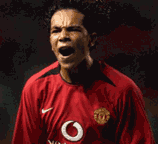
And think how pleased cousin Charley will be to come out and find herself related to a famous Sunderland player (I am told that when this piece of news was announced in the "house" Charley didn't appear to know where Sunderland was).
It proves again that you're lucky if a couple of players from even the best youth teams make it as first-team regulars, especially at United.
Flicking around some of the archived blog threads from 2002, the names most frequently mentioned as youngsters likely to break through into the first team squad were Richardson, Mads Timm (see below) and, perhaps surprisingly, the Scottish player.
So the stars of the 2003 FA Youth Cup winning side are gradually diminishing at Old Trafford and there are now only three left. David Jones (the captain) could probably have stayed longer, but decided to leave last year, and won promotion with Derby. Phil Bardsley may yet stay at Old Trafford, but is clearly free to go if a decent offer emerges (and I have even seen him proposed as an England right-back of the future). Chris Eagles will have at least one more season in the first-team squad, to see if he can kick on, particularly after a couple of goals on the Asian tour. Tom Heaton is still on the books, although goalkeepers are always a bit different.
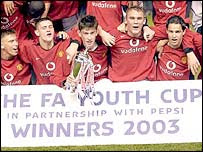
For the whole squad :
Luke Steele (GK) : at one point left as United's second-choice keeper, departed in 2006 for West Brom, as part of the deal that brought Tomas Kuszczak to United, although he has spent most of his time with them on loan at Coventry.
Phil Bardsley (DF) : lived in the shadow of The Cliff, and joined the United academy at 8 years old; still at Old Trafford, had a colourful loan spell at Rangers, more recently on loan to Villa and now strongly rumoured to be on his way to Everton.
Paul McShane (DF) : spent a successful season on loan at Brighton in 2005-06,where he was Player of the Season, before United sold him to West Brom along with Luke Steele; successful international debut for Republic of Ireland last season; recently bought by Keano for Sunderland and will join Kieran there this season.
Lee Sims (DF) : can't really find out what happened to him, after a trial at Cardiff in 2004 (although that same year on Championship Manager one bloke brought Sims in for Gary Neville, pushed up his value to £7 million and had him playing for England -amazing where Google will take you and, sadly, probably the closest Lee Sims will ever come to fame).
Lee Lawrence (DF) : loaned to Shrewsbury in 2004, released by United when the Pontins League side was discontinued, played for Livingston in Scotland but current whereabouts unclear.
David Jones (MF) : see above, sold to Derby County for £1 million, which Billy Davies reckoned was one of his best bargains ever, saving some £3\4 million on his real value; left-footed and eligible to play for both England and Wales; will be interesting to see how he manages in the Premiership.
Kieran Richardson (MF) : see above, sold to Sunderland for something that may presumably amount to £5.5 million if Sunderland reach Europe and Kieran scores a hat-trick for England.
Chris Eagles (MF) : see above, still at United, some eye=catching goals in Asia and is being talked up by SAF at the moment.
Eddie Johnson (FW) : after various loan spells, one of seven players released by United at the end of 2005-06, and moved to Bradford City.
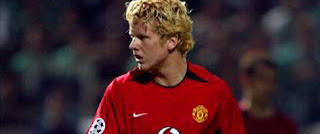
Mads Timm (FW) (above) : once the most glittering of the young prospects, ("seasoned observers like Bryan Robson were left in awe by the FA Youth Cup semi-final performance of Manchester United's Danish star" - "different class" says Barry Fry), sent to a YOI for 12 months in 2005 for dangerous driving after racing another United youngster on public roads, was supported by United and returned to the club on release, but one of seven players released by United at the end of 2005-06 and returned to OB, one of his previous Danish clubs.
Ben Collett (MF) : young player of the year in 2003, another victim of the loss of a reserve team in 2005, adventurously moved first to New Zealand Knights and then on to Dutch club Apeldoorn. Currently involved in a claim for damages against Middlesbrough FC and Gary Smith, for a leg-breaking tackle in May 2003. According to his lawyer, "Ben was one of Manchester United’s most talented young footballers, but the seriousness of this injury ended his prospects of a promising future in the Premier League at the age of just 18. We expect that the damage to his career and loss of earnings will result in significant compensation."
Tom Heaton (GK) : loaned to Swindon last season, still at United and in the squad touring Asia.
Mark Howard (MF) : one of seven players released by United at the end of 2005-06 season, moved to Danish club Brondby.
Phil Picken (DF) : loaned to Chesterfield in 2005 and subsequently moved there permanently; recently had an operation for a double hernia but should be fit for the start of the new season.
Ramon Calliste (FW) : Welsh youth international who, strangely, in view of all the current fuss, was one of two United youngsters who quietly moved to Liverpool in 2005; he could have moved to Colchester instead, but according to their manager in July 2005, "Ramon won't be staying with us. I liked what I saw in the games he played and worked hard to negotiate a contract with him, but it came down to us having to make him our best paid player to get him here....Ramon's agent asked me where his fee was coming from and if he wasn't getting it, Ramon would be going elsewhere. At that stage, I knew it was unlikely the deal would go through" - obviously Liverpool offered more than the £450 a week Colchester put on the table; released after a season in Liverpool reserves, moved to Scunthorpe but broke an ankle, failed to make their team and was released at the end of last season.
Sylvan Ebanks-Blake (FW) : another of those Liverpool fans that creep through at United, he did at least score a goal for United (in the Carling Cup), broke a leg in 2005 but recovered well and sold to Plymouth in 2006, where he's had a fair degree of success.
David Poole (MF ) : moved to Yeovil in 2005, but then loaned by them to Stockport County in 2006 and sold to County later last season for £100,000.
Sources
mostly Wikipedia I'm afraid, with some digging around on Google
Beachcroft LLP Press Release
I see Sarah Winnerburn on Football365 has been following some similar searches, with little more success, although for some reason she has skipped over Mads Timm

And think how pleased cousin Charley will be to come out and find herself related to a famous Sunderland player (I am told that when this piece of news was announced in the "house" Charley didn't appear to know where Sunderland was).
It proves again that you're lucky if a couple of players from even the best youth teams make it as first-team regulars, especially at United.
Flicking around some of the archived blog threads from 2002, the names most frequently mentioned as youngsters likely to break through into the first team squad were Richardson, Mads Timm (see below) and, perhaps surprisingly, the Scottish player.
So the stars of the 2003 FA Youth Cup winning side are gradually diminishing at Old Trafford and there are now only three left. David Jones (the captain) could probably have stayed longer, but decided to leave last year, and won promotion with Derby. Phil Bardsley may yet stay at Old Trafford, but is clearly free to go if a decent offer emerges (and I have even seen him proposed as an England right-back of the future). Chris Eagles will have at least one more season in the first-team squad, to see if he can kick on, particularly after a couple of goals on the Asian tour. Tom Heaton is still on the books, although goalkeepers are always a bit different.

For the whole squad :
Luke Steele (GK) : at one point left as United's second-choice keeper, departed in 2006 for West Brom, as part of the deal that brought Tomas Kuszczak to United, although he has spent most of his time with them on loan at Coventry.
Phil Bardsley (DF) : lived in the shadow of The Cliff, and joined the United academy at 8 years old; still at Old Trafford, had a colourful loan spell at Rangers, more recently on loan to Villa and now strongly rumoured to be on his way to Everton.
Paul McShane (DF) : spent a successful season on loan at Brighton in 2005-06,where he was Player of the Season, before United sold him to West Brom along with Luke Steele; successful international debut for Republic of Ireland last season; recently bought by Keano for Sunderland and will join Kieran there this season.
Lee Sims (DF) : can't really find out what happened to him, after a trial at Cardiff in 2004 (although that same year on Championship Manager one bloke brought Sims in for Gary Neville, pushed up his value to £7 million and had him playing for England -amazing where Google will take you and, sadly, probably the closest Lee Sims will ever come to fame).
Lee Lawrence (DF) : loaned to Shrewsbury in 2004, released by United when the Pontins League side was discontinued, played for Livingston in Scotland but current whereabouts unclear.
David Jones (MF) : see above, sold to Derby County for £1 million, which Billy Davies reckoned was one of his best bargains ever, saving some £3\4 million on his real value; left-footed and eligible to play for both England and Wales; will be interesting to see how he manages in the Premiership.
Kieran Richardson (MF) : see above, sold to Sunderland for something that may presumably amount to £5.5 million if Sunderland reach Europe and Kieran scores a hat-trick for England.
Chris Eagles (MF) : see above, still at United, some eye=catching goals in Asia and is being talked up by SAF at the moment.
Eddie Johnson (FW) : after various loan spells, one of seven players released by United at the end of 2005-06, and moved to Bradford City.

Mads Timm (FW) (above) : once the most glittering of the young prospects, ("seasoned observers like Bryan Robson were left in awe by the FA Youth Cup semi-final performance of Manchester United's Danish star" - "different class" says Barry Fry), sent to a YOI for 12 months in 2005 for dangerous driving after racing another United youngster on public roads, was supported by United and returned to the club on release, but one of seven players released by United at the end of 2005-06 and returned to OB, one of his previous Danish clubs.
Ben Collett (MF) : young player of the year in 2003, another victim of the loss of a reserve team in 2005, adventurously moved first to New Zealand Knights and then on to Dutch club Apeldoorn. Currently involved in a claim for damages against Middlesbrough FC and Gary Smith, for a leg-breaking tackle in May 2003. According to his lawyer, "Ben was one of Manchester United’s most talented young footballers, but the seriousness of this injury ended his prospects of a promising future in the Premier League at the age of just 18. We expect that the damage to his career and loss of earnings will result in significant compensation."
Tom Heaton (GK) : loaned to Swindon last season, still at United and in the squad touring Asia.
Mark Howard (MF) : one of seven players released by United at the end of 2005-06 season, moved to Danish club Brondby.
Phil Picken (DF) : loaned to Chesterfield in 2005 and subsequently moved there permanently; recently had an operation for a double hernia but should be fit for the start of the new season.
Ramon Calliste (FW) : Welsh youth international who, strangely, in view of all the current fuss, was one of two United youngsters who quietly moved to Liverpool in 2005; he could have moved to Colchester instead, but according to their manager in July 2005, "Ramon won't be staying with us. I liked what I saw in the games he played and worked hard to negotiate a contract with him, but it came down to us having to make him our best paid player to get him here....Ramon's agent asked me where his fee was coming from and if he wasn't getting it, Ramon would be going elsewhere. At that stage, I knew it was unlikely the deal would go through" - obviously Liverpool offered more than the £450 a week Colchester put on the table; released after a season in Liverpool reserves, moved to Scunthorpe but broke an ankle, failed to make their team and was released at the end of last season.
Sylvan Ebanks-Blake (FW) : another of those Liverpool fans that creep through at United, he did at least score a goal for United (in the Carling Cup), broke a leg in 2005 but recovered well and sold to Plymouth in 2006, where he's had a fair degree of success.
David Poole (MF ) : moved to Yeovil in 2005, but then loaned by them to Stockport County in 2006 and sold to County later last season for £100,000.
Sources
mostly Wikipedia I'm afraid, with some digging around on Google
Beachcroft LLP Press Release
I see Sarah Winnerburn on Football365 has been following some similar searches, with little more success, although for some reason she has skipped over Mads Timm
Limp Along Leslie
'Limp Along Leslie' is another character who originally emerged in the DC Thomson story-papers, in his case The Wizard from 1951-1955. The stories were reprinted in the early 60s and then reproduced in picture-story form in other Thomson comics (I think The New Hotspur), in the late 60s/70s. He also featured in the first issue of Buddy another Thomson launch of 1981 (along with other recycled heroes like The Wolf of Kabul, Captain Bill Sampson, who fought for the empire in the east, along with his faithful companion Chung - a splendid native chap who smashed in bad people's skulls with an old cricket bat). Thomson were clearly convinced that, for normal people at least, the comic reading "window" was about five years and that they could recycle a story after that sort of period.
Leslie Tomson is a creative footballer, an inside-forward, and captain of a team called Darbury Rangers. Due to a childhood car accident, in which both his parents were killed, his left leg was shorter than his right, and he walked with a slight limp, hence the nickname. "Leslie could not move as fast as other players, but what he lacked in speed he more than make up for in skill and craft". Amongst his skills is an amazing ability to bend the ball, something which in those days was largely limited to foreign players (I remain convinced that there are more connotations to "banana shot" than just the shape of the fruit).
As so many characters in comics have to have a second life, if only to vary the plot and to produce situations of conflict, Leslie spends his time running Low Dyke Farm, a sheep-farm in the Peak District (well in "Peakshire") outside Dalestone for his widowed aunt.
"Leslie’s brilliant hat-trick had put the Rangers into the semi-finals of the cup. Dad Moss, the team manager, was flushed with excitement as he watched the players come in. “Les, two England selectors have been watching the game,” he said. “I reckon you’ll be well in the running for an international Cap against Scotland at Hampden Park.” “I don’t know that I want to be picked for England,” muttered Leslie. “You don’t want a Cap?” gasped Moss. “Of course I do!” snapped Leslie. “But the Hampden Park match is on the same day as the National Sheepdog Trial, and I’ve entered Pal.” Leslie referred to his small black and white sheepdog. Leslie’s father, the late John Tomson, had won an International Trial with his famous dog, Skipper. He had also been captain of the Rangers and an England internationalist. Les wanted to follow in his footsteps. Now it looked as if Leslie might have to sacrifice one ambition for the sake of the other."
Limp Along Leslie 18 episodes in The Wizard issues 1302 – 1313 (1951)
Limp Along Leslie 37 episodes in The Wizard issues 1333 - 1369 (1951 – 1952)
Limp Along Leslie 35 episodes in The Wizard issues 1386 - 1420 (1952 - 1953)
Limp Along Leslie in Summer 3 episodes in The Wizard issues 1429 - 1430 (1953)
The Wild Man of the Rangers 34 episodes in The Wizard issues 1439 - 1472 (1953 - 1954)
He Never Said a Word 20 episodes in The Wizard issues 1490 - 1509 (1954 - 1955)
Limp Along Leslie 9 episodes in The Wizard issues 1541 - 1549 (1955)
Limp Along Leslie 52 episodes (Reprint of two series) in The Wizard issues 1740 – 1791 (1959 - 1960)
Mister Ninety Minutes 34 episodes (Reprint of The Wild Man of the Rangers) in The Wizard issues 1854 – 1887 (1961 - 1962)
Source : http://www.britishcomics.20m.com/home.htm Vic Whittle's marvellous site.
Friday, 20 July 2007
A World of Brighter Colours

"Defence is negation; attack, as we saw it, perfectly executed, is life, and on Saturday we were taken by the hand and led into a world where the colours were a bit brighter and the outlines sharper."
Geoffrey Green, The Times : match report of the 1948 Cup Final
The Unbeatable Manny Critch
This story was in the Rover in 1966, to fit in with the World Cup finals.
It featured the ultimate giantkillers, a small island nation (somewhere in the Pacific I fancy) who enter the World Cup and get to the finals, because they have a goalkeeper who never concedes a goal. The rest of the team are pretty much there to make up the numbers, although I think there is one chap who occasionally scores a goal so they can win 1-0.
In fact, the team get all the way to the final of the World Cup and, eventually, lose on the toss of a coin, because no-one can break the deadlock. Manny Kritch, the goalkeeper, gets to call the toss and gets it wrong.
The historical interest, of course, is that in 1966, there was clearly no provision for a penalty shoot-out. If there had been, one must assume that a small Pacific island would have been world cup winners, and Kenneth Wolstenholme, Sir Geoff Hurst et al would never have had their moment of fame.
Subscribe to:
Posts (Atom)